Project
6-Axis Robotic Arm — CATIA V5
Technology
Year
2024
Context
Personal project to design a complete 6-axis robotic arm in CATIA V5, from individually modeling each component to building the final mechanical assembly, aimed at understanding and structuring the mechanical architecture of a multi-axis robotic system.
Constraints
Each component had to be modeled individually and then integrated into a coherent assembly. Particular attention was paid to joint placement, the organization of the different rotation axes, and the arrangement of mechanical links, in order to reproduce a realistic robotic arm architecture.
My Role
Sole designer: modeled the mechanical components, designed the base and the different arm links, assembled everything in CATIA V5, defined the assembly constraints, integrated the joints, and designed the end effector / gripper.
Approach
Part modeling. The robotic arm's different components — base, arm links, supports, joints, and gripper — were each designed and modeled individually in CATIA V5 before being integrated into the overall assembly.
Assembly and constraints. Components were then integrated into a complete assembly. Assembly constraints and the relative positioning of parts were defined to achieve a coherent mechanical architecture, correctly organized around the different axes.
Mechanism development. The arm's architecture was built around 6 rotation axes, with particular attention paid to the sequencing of joints and the layout of the mechanical links, to produce a coherent representation of the robot's movements.
End effector. A robotic gripper was modeled and integrated at the end of the arm to complete the mechanical architecture and represent the full system, from the base through to the effector.
Results
Complete 6-axis robotic arm designed and assembled in CATIA V5, including component modeling, joint integration, definition of the mechanical architecture, and design of the end effector. The project built a stronger understanding of complex mechanical assembly design, degree-of-freedom organization, and multi-axis mechanism design.
Limitations
No advanced kinematic analysis, structural analysis, load study, or actuator sizing was performed. The project was primarily oriented toward CAD design, mechanical modeling, and the organization of a multi-axis robotic assembly, rather than full industrial validation of the robot.
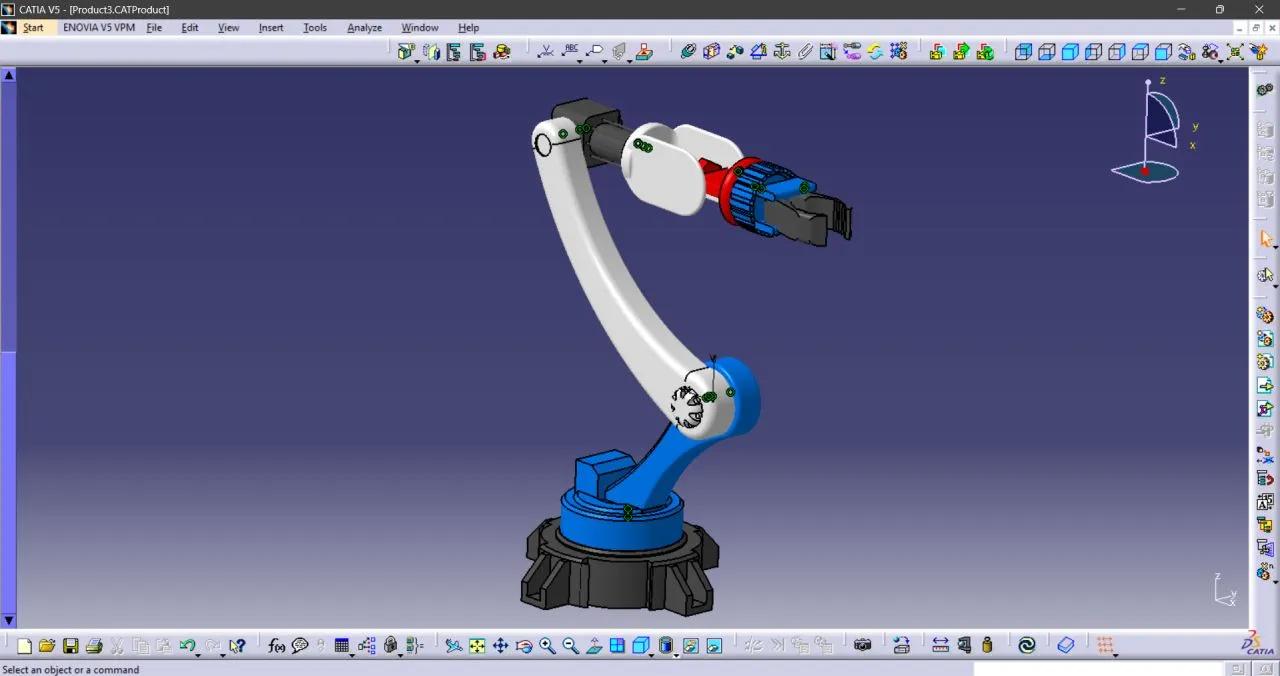
Full assembly — 6-axis robotic arm, isometric view
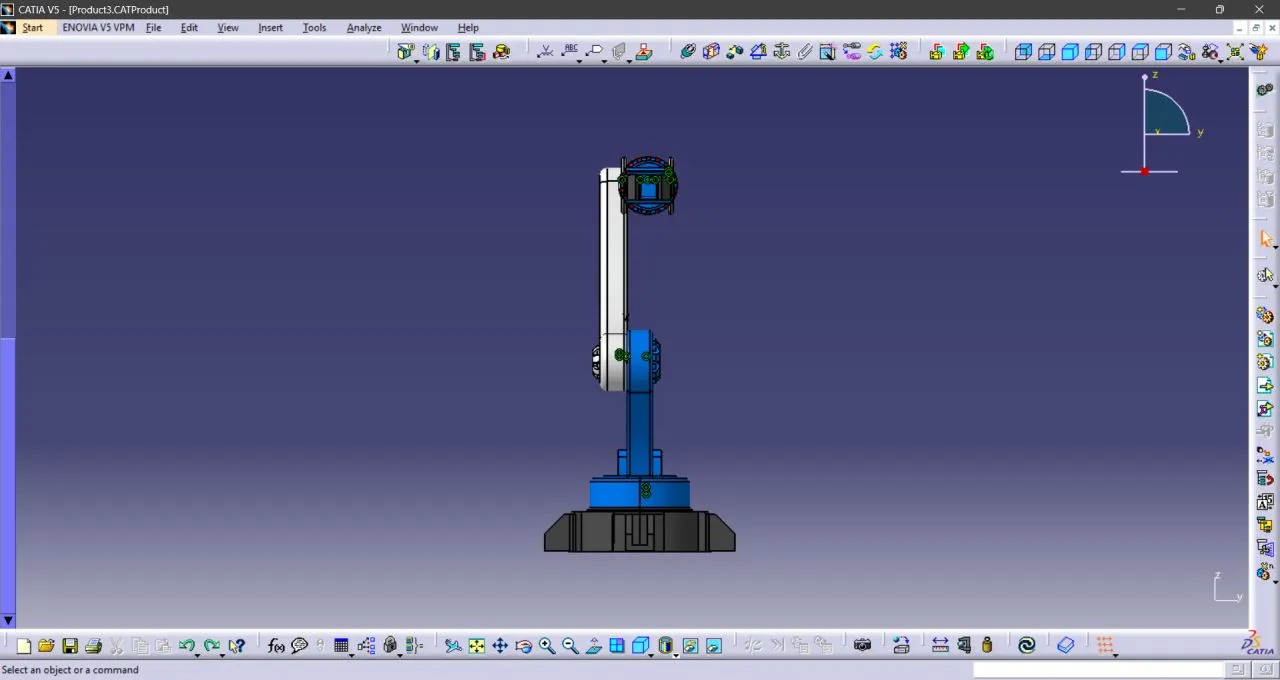
Front elevation — base, arm, and wrist assembly
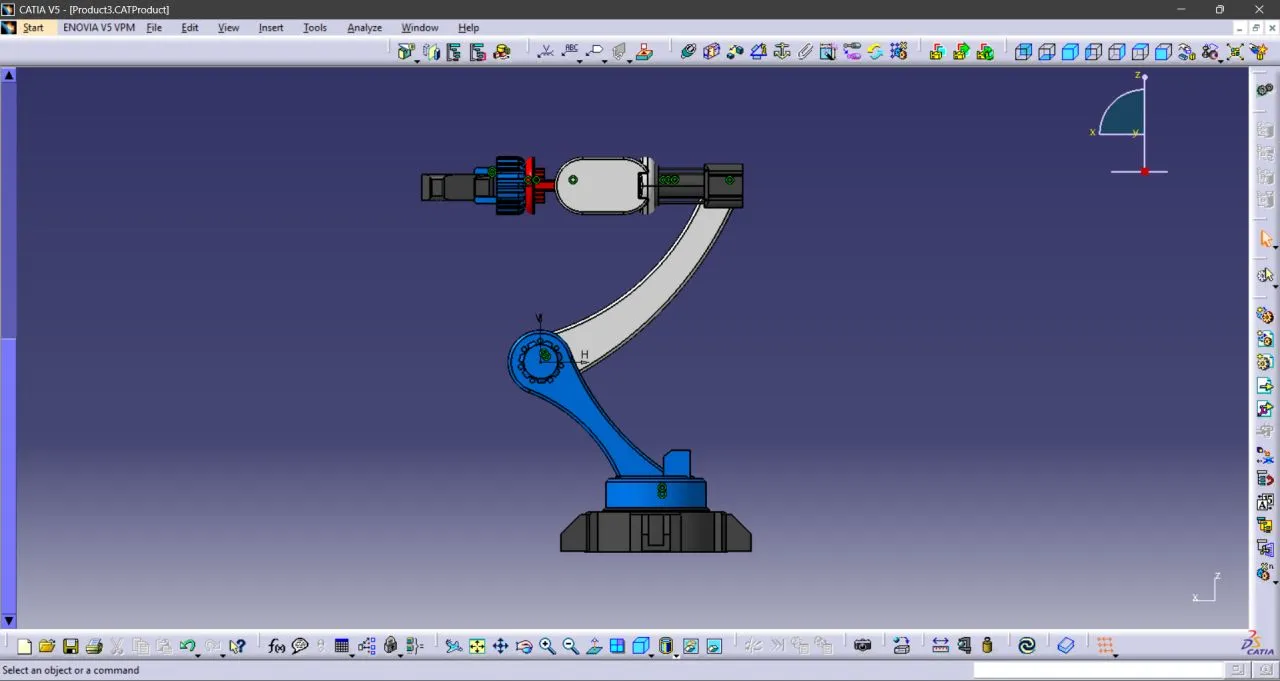
Side view — arm reaching pose, base to gripper
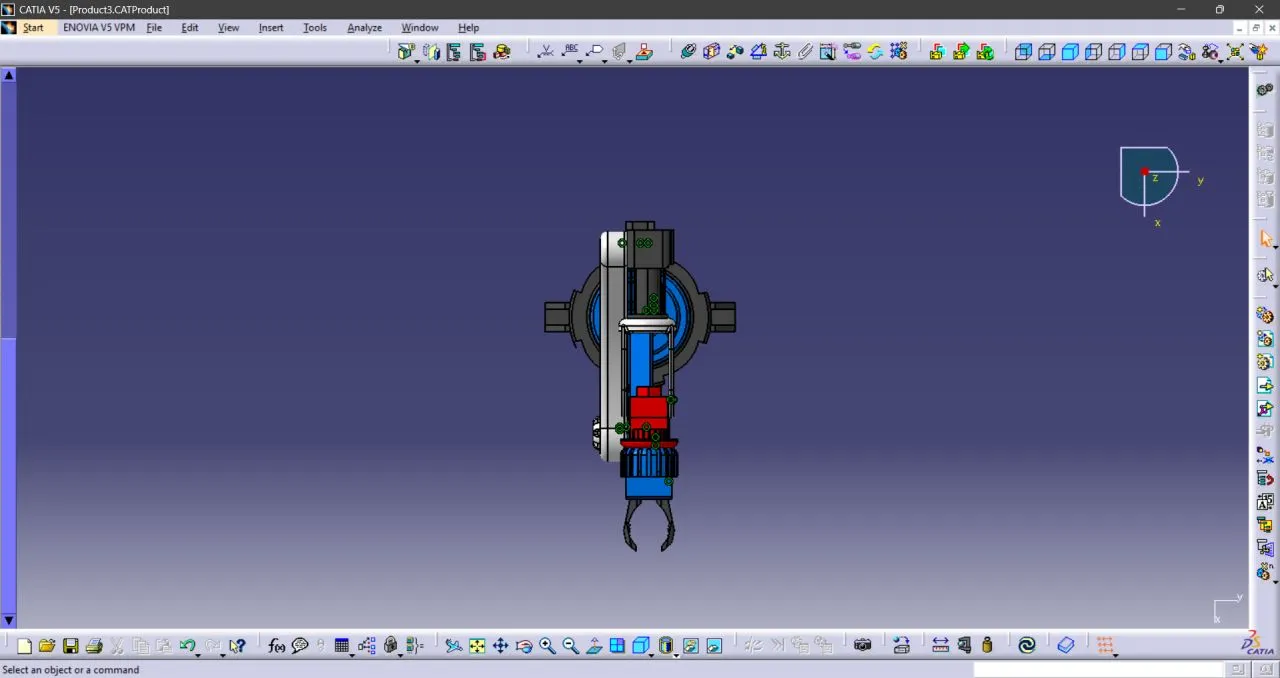
Wrist joint — close-up detail
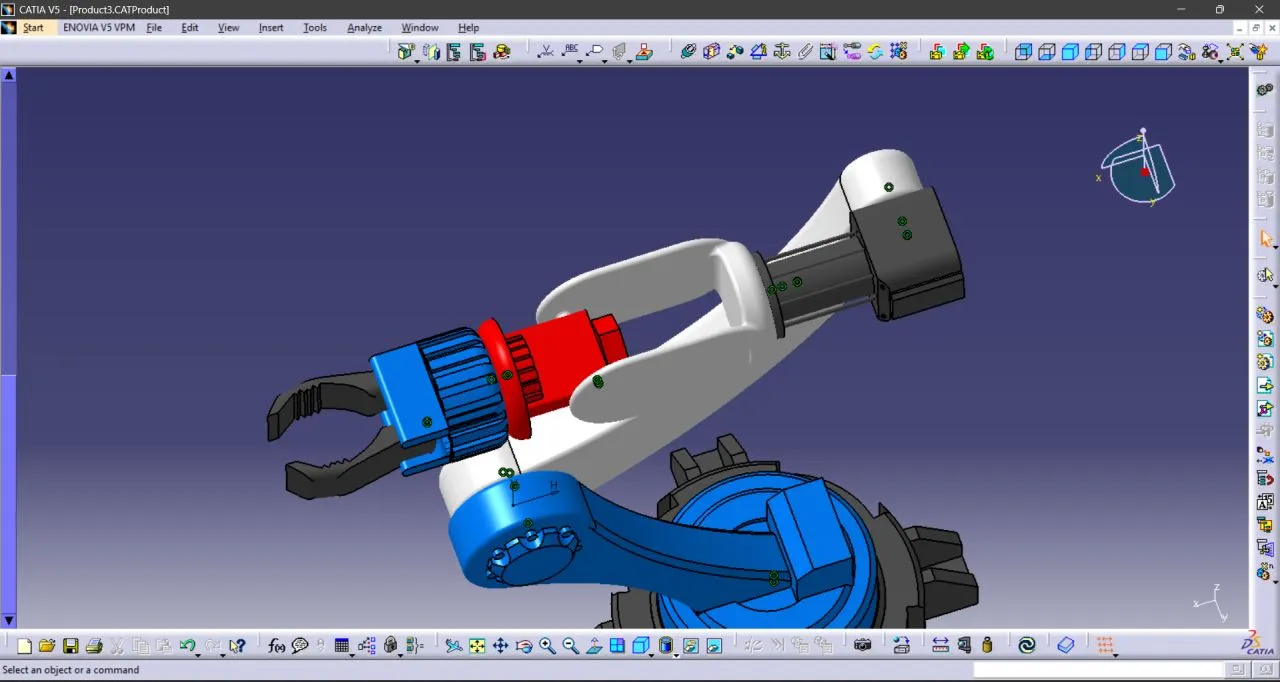
End effector — gripper close-up